Table of Contents
Interesting Facts About Honey Bees Nobody Really Talks About
Okay, real talk. Most of us see a bee buzzing around and either panic or wave it away. I get it. But hear me out — honey bees are genuinely one of the most extraordinary creatures on this planet, and the more you actually learn about them, the more you realize how much we take them for granted.
I went down a bit of a rabbit hole reading about bees a while back, and some of what I found genuinely surprised me. Not in a dry, textbook way — more like a ‘wait, that can’t be real’ kind of surprised. So here are the interesting facts about honey bees that stuck with me the most.
A Hive Is Not Just a Group of Bees — It Thinks Like One
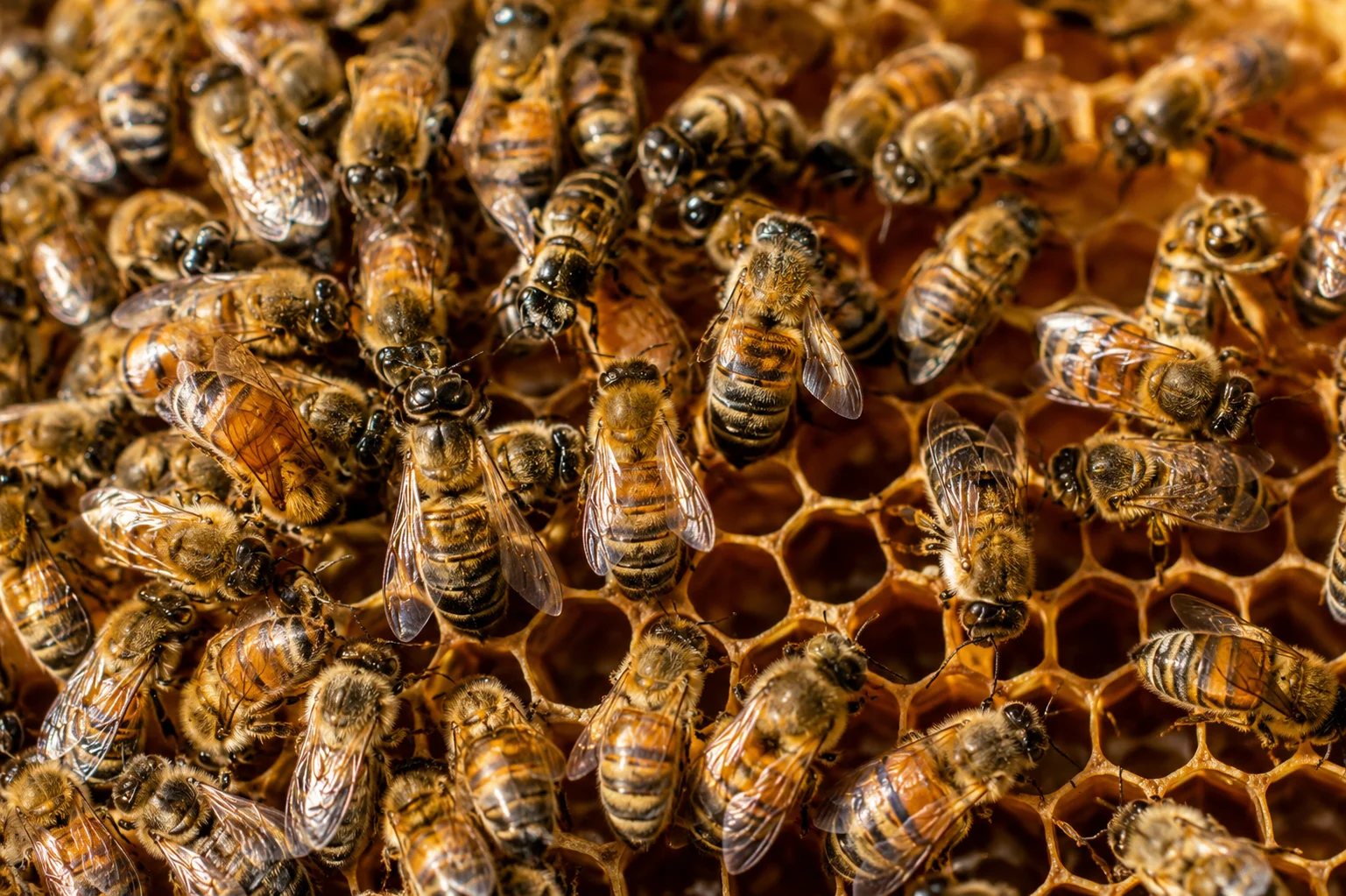
This one genuinely messed with my head. A beehive is not just thousands of insects sharing a space. The whole colony functions more like a single mind. Each bee has a role so specific that the hive would fall apart without it.
During summer, a strong hive has somewhere between 60,000 and 80,000 bees. All the work — collecting food, building comb, nursing babies, guarding the entrance, even fanning the air inside to keep things cool — is handled by worker bees, and every single one of them is female. The queen’s only job is to lay eggs. She can drop up to 2,000 of them in a single day, which is wild when you realize that is more than her own body weight.
The male bees — drones — exist entirely to mate with a queen. That is literally it. And once winter rolls around and food gets scarce, the workers kick the drones out. No sympathy. Just survival logic.
They Have a Dance That Works Like a GPS
This is probably the single most amazing and interesting fact about honey bees, and I still find it hard to believe, even though it is completely verified science. When a bee finds a good flower patch, she comes back to the hive and dances. Not randomly — this is a very specific, precise performance called the waggle dance.
She moves in a figure-eight pattern, and the angle of her waggle run relative to straight up tells her sisters the direction of the food relative to the sun. The length of the waggle run tells them how far away it is. Other bees watch her, decode the information, and fly out directly to the right location.
Karl von Frisch spent decades figuring this out and won a Nobel Prize for it in 1973. Think about what that actually means: an insect with a brain the size of a sesame seed is using abstract symbolic language to share map coordinates. If that does not make you feel something, I do not know what will.
Honey Bees Were Here Before Dinosaurs Were Gone
We tend to think of bees as a modern thing — like, a garden thing, a summer thing. But bees have been on this Earth for at least 130 million years. That means they were buzzing around while T. rexes were still alive. There are actual fossilized bees preserved in amber that show their anatomy has barely changed since ancient times.
The ancient Egyptians were keeping bees and harvesting honey as far back as 2400 BC. And here is the part that people almost never believe until they look it up: honey found in Egyptian tombs, thousands of years old, was still perfectly edible. Honey does not expire. Ever. The low moisture content and natural acidity mean bacteria simply cannot survive in it. Archaeologists have literally tasted it. Thousands-of-years-old honey. And it was fine.
How Honey Is Actually Made — It Is Much Weirder Than You Think
Most people assume bees just fly to flowers, collect nectar, and store it in cells. That is not even close to what actually happens.
A forager bee sucks up nectar and stores it in a special honey stomach — completely separate from her regular stomach — that she carries back to the hive. There, she passes it mouth-to-mouth to a house bee, who chews it for about 30 minutes. Chews it. The enzymes from chewing break down the complex sugars. Then that bee spreads the liquid across honeycomb cells, and other bees fan it with their wings until most of the water evaporates. What is left behind is honey. Then it gets capped with wax.
To produce one single pound of honey, the bees collectively fly roughly 55,000 miles and visit around two million flowers. One individual worker bee produces about one-twelfth of a teaspoon over her entire lifetime. One-twelfth of a teaspoon. Next time you put honey in your tea, maybe take a second to appreciate that.
Bees Can Recognize Your Face
Researchers at Cambridge University ran experiments where they trained bees to associate a specific human face with a sugar reward. The bees kept choosing the right face, even when it was rotated or shown from a different angle.
What is interesting is how they do it. Bees process faces as a whole composition rather than feature by feature. They do not look at your nose, then your chin, then your eyebrows separately. They take the whole face in at once — which is the same basic technique humans use. Whether or not that means bees could recognize you in particular is another question, but the fact that the ability exists at all is pretty remarkable for an insect.
Without Bees, Grocery Stores Would Look Very Different
You have probably heard the quote about Einstein saying that bees’ disappearance would mean humans have four years left. He probably did not actually say that, but the underlying truth is real. Honey bees pollinate roughly a third of all the food humans eat. Apples, almonds, avocados, blueberries, cucumbers, cherries, watermelon — all of it needs bees.
The global value of pollination is estimated at over 150 billion dollars a year. In the US alone, bees contribute to about 15 billion dollars in crop value. California’s almond industry — which produces around 80 percent of the world’s almonds — is so dependent on bees that beekeepers drive two million hives across the country every February just for the almond bloom. It is a massive coordinated operation that most people never hear about.
Bee Populations Are Collapsing, and It Is Serious
This is the part that should genuinely worry you. Honey bee populations have been declining sharply. Colony Collapse Disorder — where entire colonies of worker bees vanish suddenly — has devastated beekeeping operations across the US, UK, and Canada. Between 2020 and 2021, American beekeepers lost an estimated 45 percent of their managed colonies in one year.
The causes are a mix of things: pesticides (especially neonicotinoids), a parasitic mite called Varroa destructor that spreads viruses through colonies, fungal infections, habitat loss, and climate change disrupting flower bloom timing. Planting even a small patch of bee-friendly flowers — lavender, sunflowers, wildflowers — genuinely helps. So does avoiding pesticide use on flowering plants.
A Few More Wild Facts to Leave You With
Bees have five eyes — two large compound eyes and three tiny simple eyes on top of their head. They see ultraviolet light, which reveals nectar guides on flower petals invisible to us. A worker bee lives only about six weeks in summer because flying constantly literally wears out her body. The queen can live for five years. Only worker bees sting, and their stingers are barbed — which is why stinging kills them, tearing away part of their abdomen. The queen has a smooth stinger and rarely uses it. Drones cannot sting at all.
There is more to say. There is always more to say about bees. But hopefully this gives you enough to feel at least a little different next time one lands near you.
