Table of Contents
Facts About the Sahara Desert That Sound Made Up But Are Not
Facts about the Sahara Desert tend to break people’s assumptions almost immediately. Most of us picture an endless sea of golden dunes stretching to the horizon, and while that image is not wrong, it is only a small slice of what this place actually is. The Sahara covers roughly 3.6 million square miles of North Africa, an area close to the size of the entire United States, and it holds mountains, dry riverbeds, and even the occasional lake. If our earlier piece on the Amazon rainforest made you appreciate how strange Earth’s extreme environments can be, the Sahara is about to do the same thing from the opposite direction.
Just How Big Is the Sahara, Really?
The Sahara stretches across parts of eleven countries, including Algeria, Libya, Egypt, Morocco, Mali, and Sudan. It runs roughly 3,000 miles from east to west and about 1,100 miles from north to south at its widest point. To put that in perspective, you could fit the entire United Kingdom inside the Sahara more than fifteen times over.
Despite that scale, the Sahara is not uniformly sand. Only about a quarter of it is covered in sand dunes. The rest is a mix of gravel plains, rocky plateaus, dry mountains, and scattered oases that have supported human life for thousands of years.
The Sahara Was Not Always a Desert
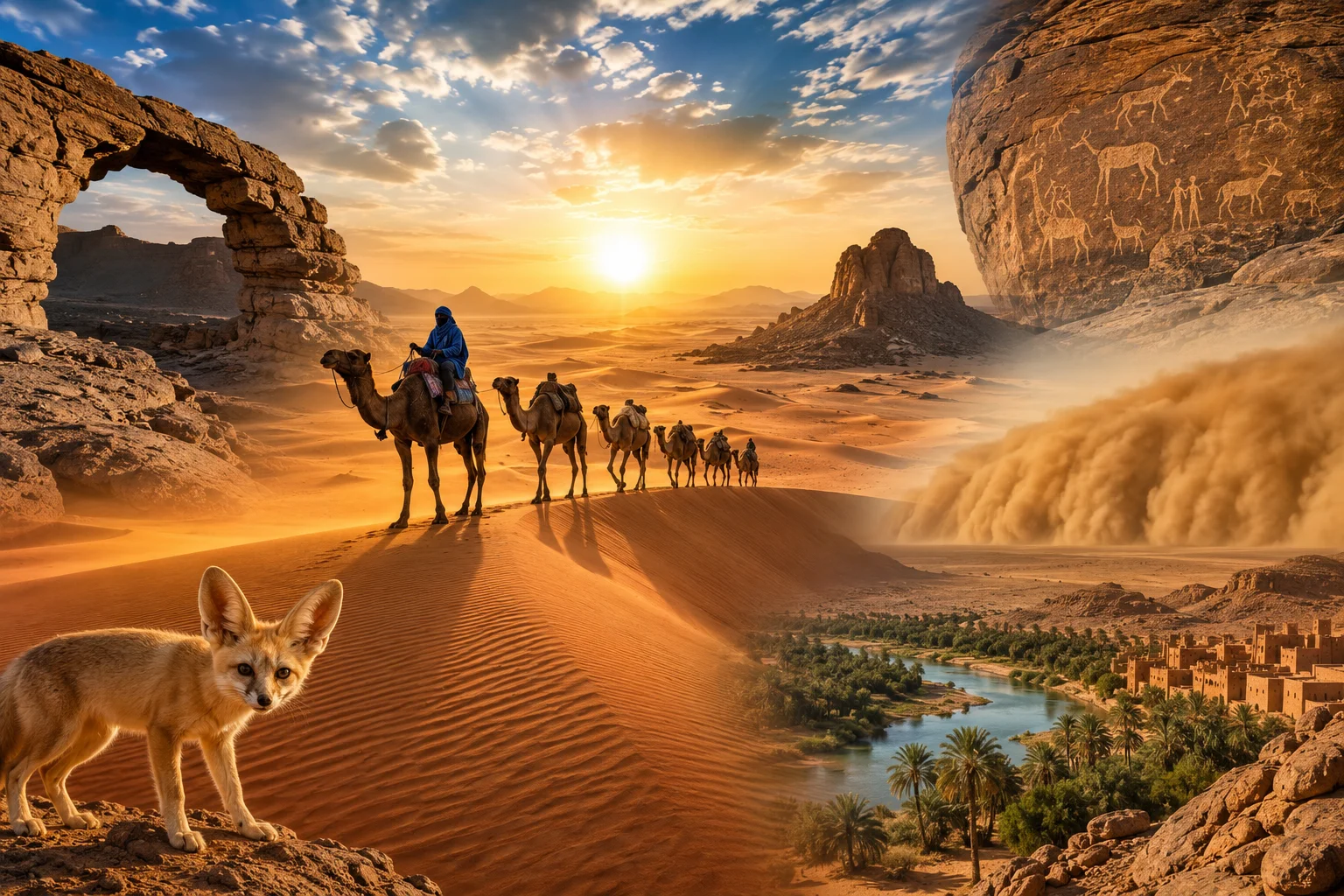
One of the most surprising facts about the Sahara Desert is that it used to be green. Around 11,000 to 5,000 years ago, during a period scientists call the African Humid Period, the region received far more rainfall and was covered in grasslands, lakes, and rivers. Ancient rock art found in places like the Tassili n’Ajjer mountains in Algeria shows giraffes, hippos, and even swimming humans, painted by people who lived there long before the sand took over. Slow shifts in Earth’s orbit eventually changed rainfall patterns, and the region dried out into the desert we know today.
It Is Not Actually the Biggest Desert on Earth
Here is a fact that surprises almost everyone: the Sahara is the largest hot desert on the planet, but it is not the largest desert overall. According to National Geographic, that title actually belongs to Antarctica, since deserts are defined by low precipitation rather than heat. The Arctic also technically counts as a desert. The Sahara still easily holds the record among hot, sandy deserts, which is usually what people picture anyway.
Temperatures Swing to Extremes
Daytime temperatures in the Sahara regularly climb above 100 degrees Fahrenheit during summer months, and the ground surface can get hot enough to make walking barefoot genuinely dangerous. What surprises most people is what happens after sunset. With almost no cloud cover or humidity to trap heat, nighttime temperatures can drop dramatically, sometimes near freezing in winter months, especially in the higher elevation areas.
This extreme daily temperature swing is part of what makes Sahara survival so difficult for both plants and animals, and it is one of the reasons desert travel historically depended so heavily on knowing exactly when to move and when to shelter.
People Actually Live in the Sahara
Despite its harsh reputation, an estimated two to four million people live within the Sahara, many of them in oasis towns or along its edges. The Tuareg, a nomadic Berber people, have crossed the desert for centuries using camel caravans to trade salt, gold, and goods between West Africa and the Mediterranean coast. Cities like Timbuktu in Mali grew wealthy centuries ago precisely because they sat along these desert trade routes, not far from the region covered in our Ancient Egypt facts article, since Egyptian civilization itself grew up right along the Sahara’s eastern edge.
The Sahara’s Underground Water Reserves
Even though rain rarely falls across most of the Sahara, the desert sits on top of one of the largest groundwater systems on Earth, known as the Nubian Sandstone Aquifer System. This fossil water was trapped underground thousands of years ago during the wetter African Humid Period, and it now stretches beneath Egypt, Libya, Chad, and Sudan. Countries in the region have tapped into it for irrigation and drinking water, though scientists caution that because it is not being naturally refilled at any meaningful rate, it is essentially a finite resource being slowly drawn down.
Wildlife That Thrives in the Sahara
Life in the Sahara has had to adapt in extreme ways. The fennec fox, the smallest fox species in the world, has oversized ears that radiate heat and help it stay cool. Dromedary camels can go for over a week without water, and their humps store fat rather than water, which is a common misconception. Addax antelope, horned vipers, and desert monitor lizards round out a surprisingly diverse list of species that have found ways to survive with almost no rainfall.
Even scorpions and certain beetles found in Saharan sand have evolved specialized ways to collect the tiny amount of moisture available from morning fog, showing just how far evolution can stretch to make a place livable.
The Sahara Is Growing
Research has shown that the Sahara has expanded by roughly ten percent since 1920, a process driven by a mix of natural climate cycles and human activity such as deforestation and overgrazing along its borders. This process, called desertification, threatens agricultural land across the Sahel region just south of the desert, pushing communities to adapt or relocate. Saharan dust does not just stay local either; NASA has tracked massive dust plumes from the Sahara traveling all the way across the Atlantic Ocean, where they affect air quality and even fertilize soil in the Amazon rainforest thousands of miles away.
The Sahara’s Role in Ancient Trade and Culture
For centuries, the Sahara was not just a barrier between North and West Africa, it was a highway. Camel caravans carrying salt, gold, ivory, and textiles crossed the desert along established routes, connecting kingdoms like Mali and Songhai to markets across the Mediterranean and the Middle East. Salt was so valuable along these trade routes that it was sometimes traded pound for pound with gold.
This trade shaped entire civilizations. Wealthy trading cities rose along the desert’s edges, universities and libraries were built in places like Timbuktu, and the movement of goods carried ideas, religion, and technology across the desert just as effectively as it carried merchandise. Understanding this history makes it clear that the Sahara has always been less of an empty void and more of a connective thread running through African history.
Surprising and Random Sahara Facts
- The highest sand dunes in the Sahara can reach over 500 feet tall.
- The hottest air temperature ever recorded on Earth, 136 degrees Fahrenheit, was measured in the Libyan Sahara in 1922, though the reading is now considered questionable by some meteorologists.
- Snow has fallen in the Sahara several times in recent decades, briefly dusting the dunes near Ain Sefra, Algeria.
- The Sahara contains dry riverbeds called wadis that can flash flood after rare, intense rainstorms.
- Beneath parts of the Sahara sits a massive underground reserve of fossil water, trapped since the region was green thousands of years ago.
Final Thoughts on These Facts About the Sahara Desert
The Sahara is far stranger and more alive than its reputation suggests. It has been green, it is slowly expanding, it is home to millions of people, and it still holds fossil water from thousands of years ago beneath its dunes. These facts about the Sahara Desert are a reminder that even Earth’s harshest landscapes have a much more complicated story than they first appear. If deserts and wild landscapes are your thing, our article on deep sea animals is a good next stop for a completely different kind of extreme environment.
