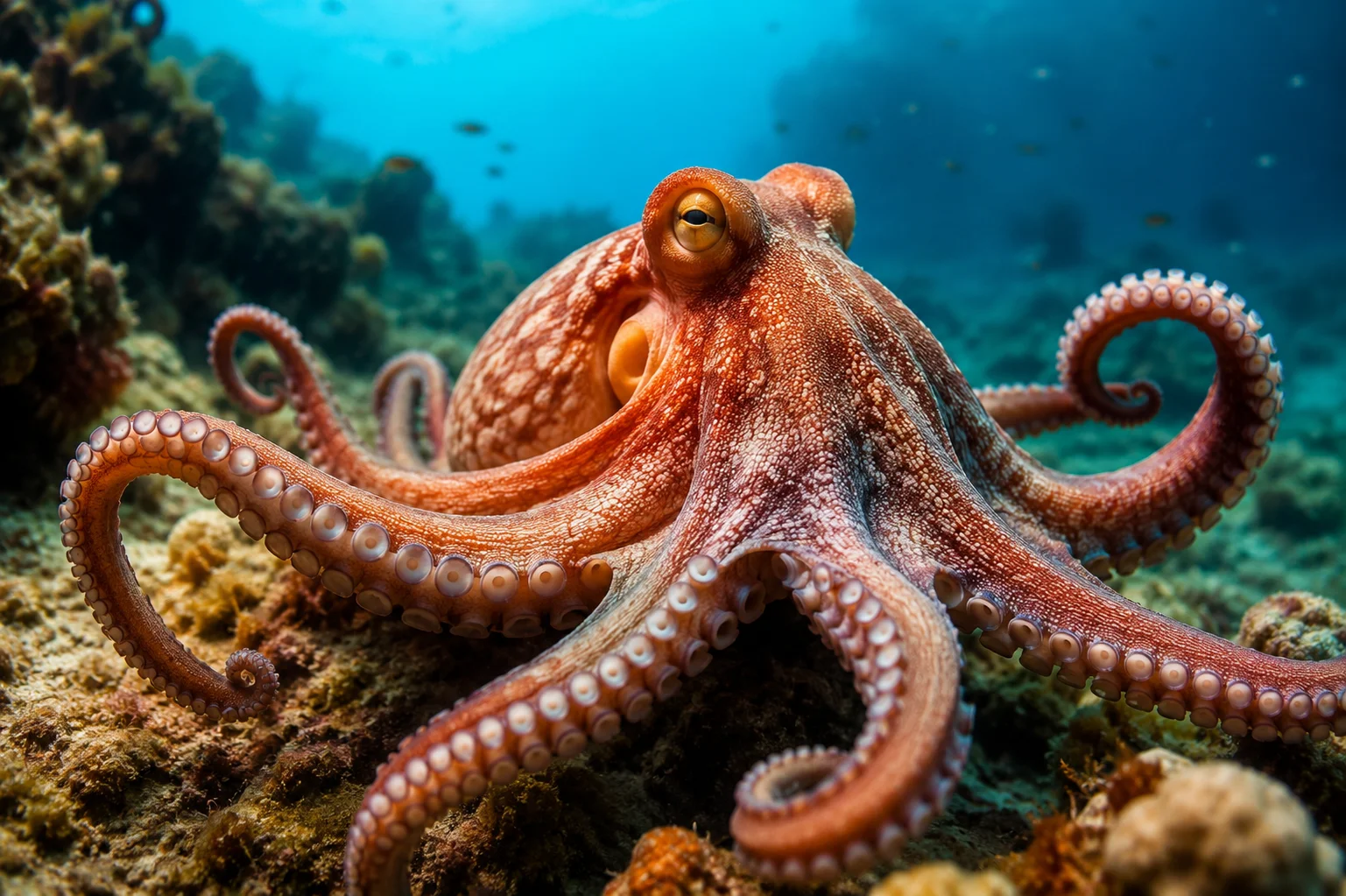
If you think you know the ocean, wait until you dig into the real facts about octopuses. These creatures are so bizarre, so brilliantly built, and so far outside what most people expect from an animal, that learning about them genuinely feels like discovering life on another planet. And the best part? They’ve been hiding in plain sight in the world’s oceans for over 300 million years.
Whether you’re a marine biology enthusiast or someone who just stumbled across a viral video of an octopus opening a jar, this deep dive into octopus fun facts is going to leave you equal parts amazed and slightly unsettled — in the best possible way.
Table of Contents
Facts About Octopuses: The Basics That Already Break Your Brain
Let’s start with the foundational stuff, because even the basics are wildly interesting when it comes to octopuses.
1. Octopuses have three hearts. That’s not a typo. Two branchial hearts pump blood through each of the two gills, while a third systemic heart circulates blood through the rest of the body. And here’s the kicker — when an octopus swims, that main heart actually stops beating, which is why they prefer crawling. Swimming literally exhausts them.
2. Their blood is blue. Instead of iron-based hemoglobin (which makes our blood red), octopuses use copper-based hemocyanin to transport oxygen. This makes their blood a vivid blue color. It’s also more efficient at carrying oxygen in cold, low-oxygen environments — a neat evolutionary trade-off.
3. They have nine brains. Well, sort of. Octopuses have one central brain, but each of their eight arms contains its own cluster of neurons — essentially a mini-brain — that can act independently. An arm can react to stimuli and make local decisions even without input from the central brain. This kind of distributed intelligence is almost unheard of in the animal kingdom.
4. They’re incredibly short-lived. Despite being one of the most intelligent invertebrates on Earth, most octopus species only live 1 to 2 years. Some species live just 6 months. Giant Pacific octopuses, one of the largest species, live around 3 to 5 years at most. It’s one of nature’s great ironies — so much brainpower, so little time.
Interesting Octopus Facts About Their Incredible Intelligence
Octopus intelligence is the stuff of legend among marine biologists, and for good reason. The more researchers study these animals, the more their cognitive abilities surprise us.
5. They can solve puzzles and use tools. Octopuses have been observed unscrewing jars to reach food inside, navigating mazes, and even using coconut shells as portable shelters — carrying them across the ocean floor and assembling them into a makeshift dome when needed. Tool use was once considered a uniquely human trait, then a primate one. Octopuses haven’t read that memo.
6. They have distinct personalities. Scientists at the Seattle Aquarium spent years observing octopuses and found that individuals had consistent, recognizable personalities — some shy, some bold, some aggressive, some playful. Some octopuses even squirted water at researchers they didn’t like. The study of animal personalities, called “animal temperament research,” now regularly includes cephalopods like octopuses.
7. They can recognize human faces. In experiments, octopuses were exposed to specific humans who either fed them or mildly irritated them. Over time, they began reacting differently to each person — approaching the friendly one, retreating from or squirting at the irritating one. This level of individual recognition in an invertebrate is extraordinary.
8. They learn by watching others. Octopuses can observe another octopus performing a task and replicate it — a form of social learning that implies observation, memory, and intentional imitation. Given that octopuses are largely solitary animals, this skill is all the more remarkable.
Amazing Octopus Anatomy Facts
The physical design of an octopus is just as impressive as its intelligence. Evolution has produced something truly alien here.
9. Their arms can regrow. If an octopus loses an arm to a predator — which happens fairly often — it can regenerate a new one. The new arm grows back, complete with suckers and full functionality. It’s not instant, but it works. Some species can even regrow an arm within a few weeks.
10. Their suckers are incredibly sensitive. Each of an octopus’s suckers contains chemoreceptors, meaning they can smell and taste whatever they touch simultaneously. An octopus exploring an object with its arms is essentially tasting, touching, and analyzing it all at once. It’s a sensory experience we can barely imagine.
11. They can change color and texture in milliseconds. One of the most famous octopus fun facts is their camouflage ability, but the speed and precision of it is staggering. Using specialized cells called chromatophores, iridophores, and papillae, an octopus can replicate the color, pattern, and even the physical texture of its surroundings in under one second. They’ve been filmed perfectly mimicking rock, coral, sand, and even other animals.
12. They’re boneless — entirely. Octopuses have no skeleton whatsoever. Their only hard part is a small beak, made of chitin, similar to an insect’s exoskeleton. This means an octopus can squeeze through any opening larger than its beak. A large octopus can pass through a hole the size of a golf ball. For aquariums, this is a constant logistical nightmare.
Fascinating Octopus Behavior Facts
Beyond intelligence and anatomy, octopus behavior in the wild reveals just how dynamic and adaptable these creatures truly are.
13. Some octopuses are venomous. All octopus species produce venom, which they use to subdue prey like crabs and clams. Most of this venom is harmless to humans. However, the blue-ringed octopus — a tiny species found in the Pacific and Indian Oceans — carries venom powerful enough to kill an adult human. It’s considered one of the most dangerous marine animals in the world. According to National Geographic, it has no known antidote.
14. Females die for their eggs. After laying eggs, a female octopus dedicates the rest of her life to protecting them. She stops eating entirely and constantly aerates the eggs with water from her arms. She typically dies shortly after the eggs hatch. It’s one of the most dramatic examples of parental sacrifice in the animal world.
15. They use ink as a defensive weapon. When threatened, octopuses release a dark, mucus-rich ink cloud from a specialized organ. The ink doesn’t just obscure vision — it also contains tyrosinase, a compound that dulls a predator’s sense of smell and temporarily paralyzes their chemoreceptors. It’s a chemical weapon as much as a visual one.
16. Males have a special reproductive arm. One of an octopus’s eight arms — called the hectocotylus — is specifically modified for reproduction. In some species, the male detaches this arm and leaves it with the female. She then uses it to fertilize her eggs. The male, incredibly, can survive without it.
Ocean Animal Facts: How Octopuses Fit the Bigger Picture
Octopuses don’t exist in isolation. They’re a fascinating piece of the broader ocean ecosystem, and understanding them helps us appreciate the underwater world more deeply.
17. They’re a keystone species in many marine ecosystems. Octopuses regulate populations of the crustaceans and mollusks they hunt. Remove them, and prey populations can explode in ways that destabilize entire reef ecosystems. Like honey bees on land, certain marine animals play disproportionately large roles in keeping ecosystems balanced.
18. They’ve been on Earth far longer than humans. Fossil evidence shows that octopus ancestors existed over 300 million years ago, long before the dinosaurs. They’ve survived multiple mass extinction events. For context, modern humans have been around for roughly 300,000 years. Octopuses are an ancient, extraordinarily resilient lineage.
19. Their intelligence evolved independently from vertebrates. The common ancestor of octopuses and vertebrates (like fish or humans) had almost no neurons. Octopus intelligence and our own intelligence evolved completely separately. They are, in a very real sense, a parallel experiment in the evolution of complex cognition — as the Smithsonian Ocean portal notes, they represent a completely independent path to intelligence.
20. They may dream. Researchers in 2021 observed a sleeping octopus rapidly changing colors and patterns — flashing through a range of hues in what looked remarkably like a REM sleep cycle in mammals. Scientists believe this could be evidence of dreaming, or at least active memory consolidation during sleep. Much like pink river dolphins and other animals that continue to surprise us, octopuses remind us how much we still don’t know about non-human minds.
Final Thoughts
The facts about octopuses are the kind that stick with you. They don’t just fill in a blank on a trivia card — they genuinely shift how you see the natural world. An animal with three hearts, nine brains, blue blood, and the ability to dream is not something evolution had to produce. And yet here they are, gliding quietly through the ocean, solving problems and squirting water at people they don’t like.
If you found these interesting octopus facts as mind-blowing as we did, explore more amazing animal stories in the Animals section of The Fact Journal. There’s always more to discover.
