Table of Contents
Facts About Jellyfish That Will Change How You See the Ocean
Facts about jellyfish have a strange way of turning casual curiosity into a full-blown obsession. Maybe you saw one glowing on a nature documentary at 1 AM, or maybe you got stung on a beach vacation and suddenly needed answers. Either way, jellyfish are one of those creatures that look simple on the surface, just a blob floating in the current, until you start digging into how they actually work.
They have been drifting through the oceans since before trees existed, they do not have a brain, and some of them can essentially reset their own biological clock. If you enjoyed our deep dive into
They have been drifting through the oceans since before trees existed, they do not have a brain, and some of them can essentially reset their own biological clock. If you enjoyed our earlier look at deep sea animals, this list of facts about jellyfish is going to hit the same nerve. Grab a coffee, because some of these are genuinely hard to believe.
What Exactly Is a Jellyfish?
Before we get into the wilder facts about jellyfish, it helps to know what we are actually talking about. Jellyfish are not fish at all. They belong to a group of animals called cnidarians, the same family that includes coral and sea anemones. A jellyfish is made up of roughly 95 percent water, with a soft, bell-shaped body called a medusa and a curtain of trailing tentacles lined with stinging cells.
Instead of a brain, a jellyfish runs on something called a nerve net, a loose web of nerve cells spread across its body that senses light, touch, and chemicals in the water. It sounds primitive, but it works well enough that jellyfish have outlived almost every other creature on this list of ocean survivors.
Jellyfish Have Been Around Longer Than Dinosaurs
This is usually the fact that gets people’s attention first. Fossil evidence suggests jellyfish, or something very close to them, have existed for more than 500 million years. That means jellyfish were pulsing through ancient seas long before dinosaurs walked the earth, before sharks existed, and even before trees had evolved on land.
They survived at least five mass extinction events, including the one that wiped out the dinosaurs. For context on just how much has changed since then, it is wild to think jellyfish were already ancient by the time the creatures in our Amazon rainforest article’s ancestors first appeared.
They Do Not Have Brains, Hearts, or Blood
One of the most repeated facts about jellyfish is also one of the strangest: they have no brain, no heart, and no blood. Oxygen passes directly into their bodies through a thin membrane, so they do not need lungs or gills either. Their entire nervous system is just that scattered nerve net mentioned earlier.
Despite lacking any of the organs we consider essential for animal life, jellyfish manage to hunt, avoid predators, and reproduce successfully enough to have colonized every ocean on the planet, from warm tropical shallows to the freezing waters near the poles.
Some Jellyfish Are Basically Immortal
The species Turritopsis dohrnii, nicknamed the immortal jellyfish, has a party trick unlike almost any other animal. When it is injured, sick, or simply old, it can revert its cells back to an earlier stage of life and regrow itself as a juvenile polyp, essentially starting its life cycle over again.
Scientists call this process transdifferentiation, and in theory it means this particular jellyfish could repeat the cycle indefinitely. That does not mean it cannot die from disease or being eaten, but under the right conditions, it may never die of old age at all.
Jellyfish Come in Wild Shapes and Sizes
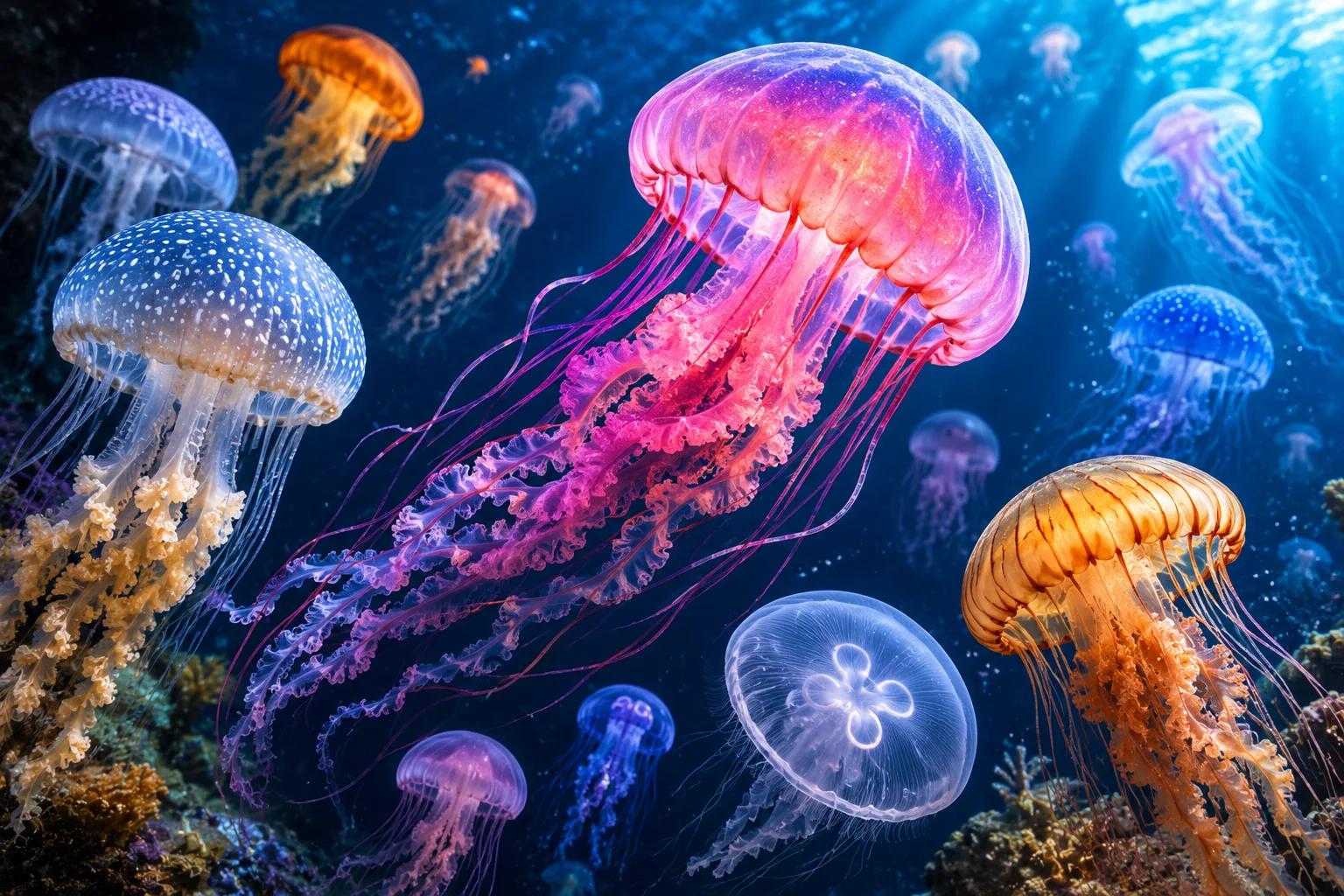
Not all jellyfish look alike, and the size range is honestly startling. The lion’s mane jellyfish is considered the longest animal on Earth by some measurements, with tentacles that can stretch beyond 100 feet when fully extended, longer than a blue whale.
On the other end of the scale, the Irukandji jellyfish is small enough to fit on a fingertip, yet it carries a sting powerful enough to send a grown adult to the hospital. Somewhere in between sits the box jellyfish, known for its cube-shaped bell and its reputation as one of the most venomous animals in the sea.
They Glow in the Dark, and It Is Not Just for Show
Several jellyfish species are bioluminescent, meaning they can produce their own light through a chemical reaction inside their bodies. The crystal jellyfish is famous for this, and the glowing protein scientists isolated from it, called green fluorescent protein, went on to win a Nobel Prize because of how widely it is now used to study cells in laboratories.
In the ocean, that glow can serve several purposes: startling predators, attracting prey, or simply signaling to other jellyfish. It is a good reminder that some of the most useful scientific tools started out as a survival trick in a drifting, brainless animal.
Jellyfish Stings: What You Actually Need to Know
Every jellyfish tentacle is lined with microscopic stinging cells called nematocysts, which fire a tiny barbed thread on contact. Most stings just cause a painful, itchy welt, but a few species, especially the box jellyfish, can be dangerous and even life-threatening. According to NOAA’s ocean research, rinsing a sting with vinegar can help stop unfired stinging cells from firing further, while the old myth about urine is not actually recommended.
If you are ever stung while swimming, the safest move is to get out of the water, rinse with vinegar or seawater rather than fresh water, and seek medical help if symptoms are severe or you are stung by a box jellyfish species.
Jellyfish Are Taking Over More of the Ocean
Marine biologists have tracked a noticeable rise in jellyfish blooms, huge swarms that can stretch for miles, in recent decades. Warmer ocean temperatures, overfishing of jellyfish predators like tuna and sea turtles, and nutrient runoff from coastlines all seem to be creating ideal conditions for jellyfish populations to explode. National Geographic has covered how these blooms can clog fishing nets, shut down power plant water intakes, and even force beaches to close.
It is a strange kind of comeback story. An animal that has survived every mass extinction in Earth’s history may end up being one of the few winners as ocean conditions shift.
How Jellyfish Reproduce
Jellyfish reproduction is more complicated than most people expect, and it usually involves two very different life stages. Adult jellyfish, called medusae, release eggs and sperm into the water, where fertilization produces a tiny free-swimming larva called a planula. That larva eventually settles on a hard surface and grows into a polyp, a small stalk-like form that looks nothing like the jellyfish most of us picture.
The polyp can then clone itself repeatedly, budding off small disc-shaped juveniles called ephyrae, which eventually grow into full adult jellyfish. This two-stage life cycle, alternating between polyp and medusa, is part of why jellyfish populations can explode so quickly when ocean conditions favor them.
Fun and Surprising Jellyfish Facts to End On
- A group of jellyfish is called a smack.
- Jellyfish are found in every ocean on Earth, from the surface down to the deep sea.
- Some jellyfish, like the upside-down jellyfish, spend most of their time resting on the seafloor instead of swimming.
- Jellyfish move by contracting and relaxing their bell, pushing water out behind them like a natural jet engine.
- Certain cultures, particularly in East Asia, have eaten jellyfish as food for centuries.
- Baby jellyfish are called ephyrae and look nothing like the adult form.
Final Thoughts on These Facts About Jellyfish
Jellyfish prove that you do not need a brain, a heart, or even blood to be one of the most successful animals in Earth’s history. From glowing predators to a species that can reverse its own aging, these facts about jellyfish are a good reminder that the ocean still has plenty of surprises left. If this list left you wanting more strange ocean life, our article on octopus facts is a great place to go next.
