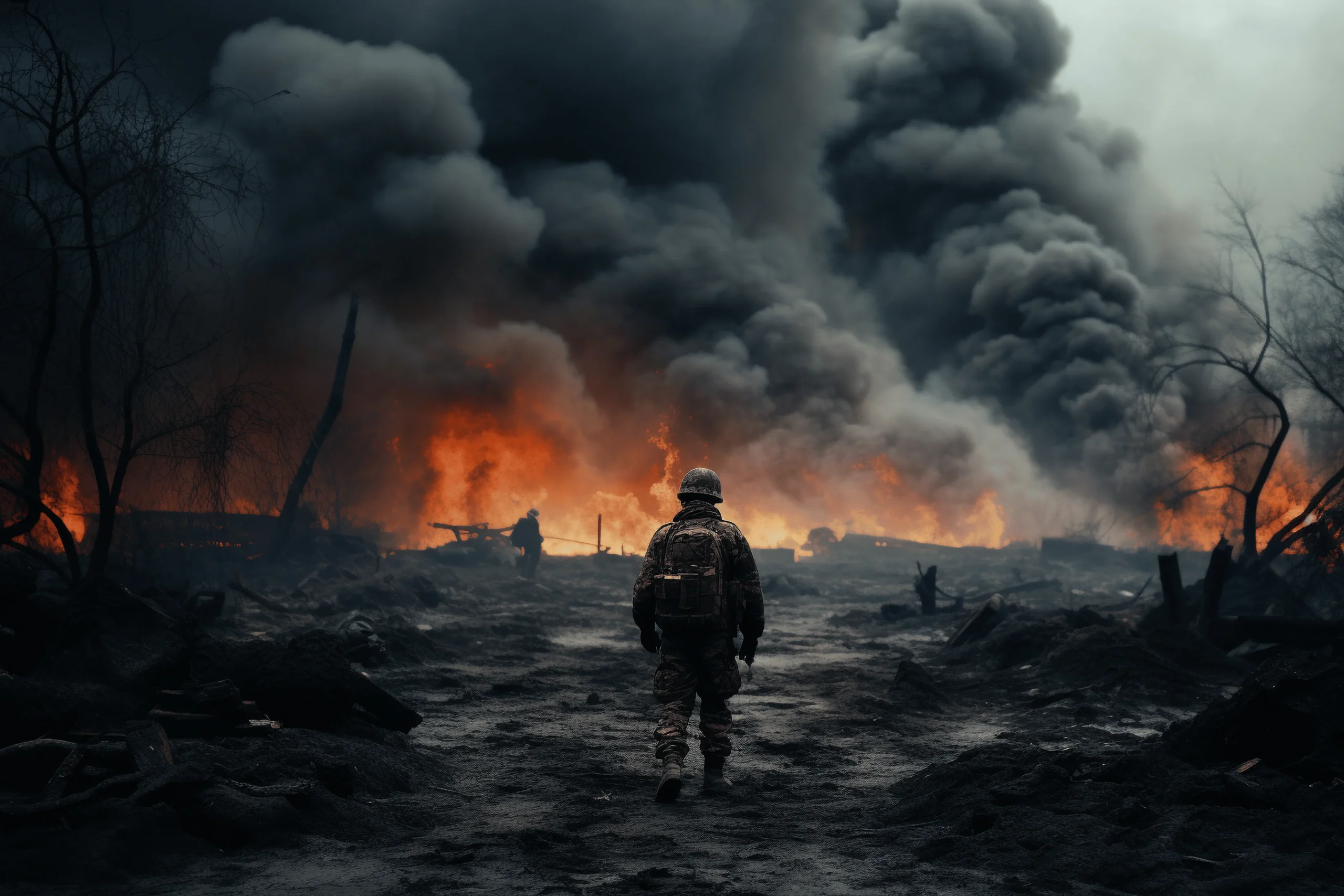
World War II stands as the deadliest and most widespread conflict in human history. Everyone is familiar with the key milestones- D-Day, Pearl Harbor, and the rise and fall of the Third Reich. However, beneath the monumental events, there is a treasure trove of unusual, surprising, and many stories that are forgotten. These lesser-known facts about World War II reveal the conflict’s complexity, its moments of humanity, and its sheer unpredictability.
Be ready to have your perception of this global war broadened. We’re diving deep into the archives to uncover 15 incredible World War II facts that will change your perspective on the war that shaped our modern world.
Table of Contents
Anthropogenic and weird coincidences.
The big picture of war is usually constructed with the little, personal events and weird turns of circumstances, which the history books frequently overlook.
1. The Soldier Who Fought on Both Sides.
Perhaps one of the most bizarre facts about World War II is the story of a Chinese soldier named Yang Kyoungjong. In fact, he began as a Korean conscript in the Japanese Imperial Army, was taken prisoner by the Soviet Red Army and made to fight on their side, was later taken prisoner by the German Wehrmacht and made to fight with one of their units, and was later captured by American paratroopers on D-Day. The remaining war he served as an American POW, having fought in three separate, conflicting armies as a soldier.
2. The Christmas Truce of World War II
The well-recognized Christmas truce of 1914 in the First World War is well known to everyone, but another, more minor, one took place in 1944. On Christmas Eve, a German woman called Elisabeth Vincken and her son had to shelter and nurse three American and four German soldiers in her remote cabin during the fierce battle of the Bulge. She persuaded the men to drop their weapons during the night, and she took a simple Christmas dinner. One night, the ghost of peace conquered the fact of war.
3. A Future Movie Star-Studded Cast Served.
Almost everyone was included in the war effort, and some of the faces would be familiar to you on the silver screen. Before becoming a movie star, iconic actors such as Audie Murphy were the most decorated soldiers in the war in the U.S. James Doohan, Scotty of Star Trek, was shot six times as he stormed Juno Beach on D-Day. Even a popular children’s writer, Roald Dahl, was an air fighter ace in the Royal Air Force! These personal stories add a deeply human element to the vast history of World War II.
The Weapons and the Military Oddities.
In an attempt to gain an advantage in the desperate fight, everyone came up with some of the most unusual and innovative technologies.
4. The U.S. Designed a Bat Bomb
One American project was truly innovative in its ingenuity in the search to find new weapons: the bat bomb. It was planned that small incendiary pads would be affixed to thousands of Mexican free-tailed bats and they would be turned out over Japanese cities and left to roost in the much of the buildings made of wood. The igniters would subsequently blow up and produce large-scale uncontrollable fires. The initiative was promising, but ended up being put on hold in favor of the atom bomb program.
5. The Soviets’ “Anti-Tank” Dogs
The Red Army of the Soviets was known to take desperate measures. An example of such a strategy was the employment of anti-tank dogs. These dogs were trained to be loaded with explosives underneath the enemy tanks, where they were the weakest. They were fed on and taught that there was food under the tanks. Practically, though, the dogs were commonly terror-stricken with the racket of fighting, and would flee back to their Soviet masters, instead, blowing them up. This program was mostly a failure.
6. Japan Enters Balloon Bombs on America.
One of the most daring and the least known attacks in the course of the war was that waged by the Japanese, in which they dropped more than 9,000 Fu-Go balloon bombs to the United States. These hydrogen balloons, which were carried by the jet stream, were supposed to drop incendiary and anti-personnel bombs on the forests and cities of North America. Around 300 reached the U.S., causing minimal damage but resulting in the only World War II fatalities on the American mainland due to enemy action–a pregnant woman and five children on a picnic in Oregon.
7. The Great Ghost Army
The 23rd Headquarters Special Troops, better known as the Ghost Army, conducted one of the most successful deception campaigns in the history of the military. This special group, comprising artists, engineers, and sound technicians, employed inflatable tanks, simulated radio communication, as well as huge speakers to simulate big Allied outfits. They carried out more than 20 battlefield deceptions to confuse German troops on the location and number of Allied troops, which could have saved thousands of lives.
8. World War With the Unusual Suspects.
The war was indeed a world war, as it involved countries and individuals of all parts of the world in one way or the other.
Brazil was the sole South American state that dispatched soldiers to Europe.
Although most of the Latin American countries were formally allied or even declared war, Brazil was the only South American country to deploy a complete infantry division to battle on the European front. The Brazilian Expeditionary Force (FEB) fought major battles in Italy, capturing thousands of German prisoners. Their role played a very significant, but very frequently ignored, role in the victory of the Allies.
9. The Final surrender of WWII was in 1974.
Although the war was officially over in 1945, a small group of Japanese soldiers called holdouts still maintained their hiding places in isolated Pacific islands decades later until they could accept the fact that the war had ended. The final holdout was the private Teruo Nakamura, found on the Indonesian island of Morotai, and he eventually gave up on December 18, 1974, almost 30 years after the war had concluded.
10. Poland’s Bear Soldier
A Polish II Corps, which was among the British Army, had a peculiar yet popular member, a brown Syrian bear named Wojtek. He was taken in as a cub in Iran, where he grew up with the soldiers, where he drank beer, chewed cigarettes (he would eat them all), and even wrestled with his playmates. Wojtek was officially enlisted as a private in the Battle of Monte Cassino and assisted his platoon in transporting huge crates of artillery shells. He has survived the war and spent his days in the Edinburgh Zoo.
Opposing Events and Stolen Secrets.
Even the things that we imagine we know so well also possess some concealed aspects and unexpected facts that give more variety to their background.
11. The Japanese killed the first German soldier who died in battle.
The complexities of the war’s timeline are full of surprising facts about World War II. The killing of the first German soldier in the war was not a killing done by a British, French or Polish soldier, but rather that of the Japanese. This occurred in 1937 during the Battle of Nanjing, part of the Second Sino-Japanese War, which is widely considered the starting point of World War II in the Pacific, two years before Germany invaded Poland.
12. Operation Paperclip: The Enemy Recruited.
Within the immediate aftermath of the war, a covert intelligence program by the U.S was initiated under the name Operation Paperclip. It aimed to hire German scientists, engineers, and technicians, former Nazi and engineers and technicians of the advanced weapons programs of Hitler. Germans such as Wernher von Braun, the head rocket scientist of the V-2 rocket (and later the Apollo moon program), were imported into America. They were considered to be important to the developing Cold War and the Space Race because of their knowledge.
13. The Battle of Castle Itter: Americans and Germans Fighting Together.
One of the most bizarre battles took place in Austria in Castle Itter in the last days of the war. The castle was now joined by a small number of American soldiers and a small number of German Wehrmacht soldiers commanded by Major Josef Gangl, who had also resisted the SS. They had been defending French prisoners of high profile (two former prime Ministers) against a fanatical unit of the Waffen-SS. It was the only phase of the war in which Americans and Germans became allies.
14. A Submarine Sunk a Train
One of the most innovative naval attacks of the war was developed by the U.S. Navy Commander Eugene B. Fluckey of the USS Barb. On a railroad cut, they set the explosives after landing a shore party on the coast of Karafuto, occupied by the Japanese. It was blown up when a train was passing, making it the only submarine in history to sink an enemy train.
15. The Man that Saved the World by Saying No.
The Tsar Bomba was the most powerful nuclear weapon in history, and the Soviet Union tested it on October 30, 1961, the day when the Cold War was at its peak. The man who dropped it on the pilot of the bomber was called Andrei Durnovtsev. But back in World War II, as a young lieutenant, Durnovtsev flew perilous bombing missions against the Germans. The experience that he had during that international conflict formed a generation of military leaders who would later on to navigate the challenges of the nuclear age.
Final Thoughts
The history of World War II is far more complex and nuanced than any textbook can fully capture. These 15 incredible facts about World War II remind us that history is not just about dates and generals, but about the strange coincidences, the moments of shared humanity, and the bizarre innovations born from global conflict. Through these forbidden avenues, we understand more than ever about an occasion that persists with us nowadays.
Was any of this a surprise to you? Send this article to a friend who is a history lover and maintain the dialogue about our history.
If you want to explore more fascinating blogs about countries, visit now!
